For safe driving on Turkish roads, we’ve put licence validity, speed limits, the core traffic rules, primary-fault situations and the official procedure to follow after an accident all on one page. This guide is written as a practical roadmap especially for drivers arriving in Türkiye (Turkey) with a foreign-plated vehicle.
How Long a Foreign Licence Is Valid
How long you can drive in Türkiye on a licence issued abroad is assessed together with your citizenship and residence status, document type and Türkiye entry date. If you overstay the permitted period or do not have the required translation, driving-without-a-valid-licence rules may apply.
For Turkish citizens
You may drive for 1 year from the date you enter Türkiye.
After month 6: you must carry a Turkish translation of your licence, certified by a Turkish consulate abroad or a Turkish notary.
At the end of the year: to keep driving, you need to exchange your foreign licence for a Turkish one.
For foreign nationals
You may drive for up to 6 months from the date you enter Türkiye.
At the end of the 6 months: to keep driving, you need to exchange your foreign licence for a Turkish one.
For temporary licences, or ones whose scope can’t be confirmed, the assessment is made by the competent authority.
Converting Your Licence
Once the legal period for using a foreign licence in Türkiye has run out, you can apply at a population directorate (nüfus müdürlüğü) to convert it into a Turkish licence. The conversion takes into account whether Türkiye has an agreement with the issuing country, the type of document, and the driver’s age, education, health and criminal-record requirements.
Agreement requirement
Only licences from countries that are party to the Convention on Road Traffic, or that have a bilateral agreement with Türkiye, can be converted.
Training and test
In some cases no training or test is required for conversion; however, health, age, education and criminal-record conditions are still assessed separately.
Returning the old licence
The foreign licence that’s exchanged for a Turkish one may be sent through official channels to be returned to the issuing country.
Temporary licences
Foreign licences that are temporary in nature are generally not eligible for conversion.
| Scope of foreign licence | Category issued in Türkiye |
|---|---|
| Car, minibus, pickup | Category B |
| A Category B vehicle with trailer | Category BE |
| Motorcycle | A1, A2 or A, depending on engine size/power |
| Heavy vehicles such as trucks, HGVs, buses | Category B is usually issued; extra requirements may apply for the matching category |
Driving Licence Categories
Modern driving licences define vehicle groups by separate categories. If you’re driving a foreign-plated vehicle in Türkiye, the category of the vehicle you’re using needs to match the scope of your licence.
M
Motorised bicycle, moped.
A1 / A2 / A
Motorcycle categories, based on engine size and power limits.
B
Cars and pickups. Category B also lets you drive M, B1 and F category vehicles.
BE
The category for driving a car with a trailer.
C1 / C
Truck and HGV categories.
D1 / D
Minibus and bus categories.
F
Wheeled tractor.
G
Construction/work machinery.
Traffic Rules and Primary Fault
Not following the core traffic rules while driving in Türkiye can lead to more than just a fine — it can also mean penalty points, your licence being confiscated, or being found at primary fault if there’s an accident.
Drink-driving
The legal limit is generally 0.50 per mille (‰) for private vehicles and 0.20‰ for commercial vehicles. Going over the limit can lead to your licence being confiscated.
Mobile phones
Holding a mobile phone while driving is not allowed. Hands-free systems can be used.
Seat belts
Seat belts are compulsory for the driver and every passenger, including in the back seats.
Primary-fault situations
Things like running a red light, driving the wrong way, an unsafe overtake or a rear-end collision can weigh heavily when fault is assessed after an accident.
The Penalty Points System
Drivers can be given penalty points for traffic violations. If a driver reaches 100 points within a year, their licence can be confiscated for a set period. This makes accumulating violations a serious risk, especially for drivers staying in Türkiye for a long time with a foreign-plated vehicle.
Speed Limits
Drivers should set their speed not just by the maximum limit, but also according to the road, weather, visibility, traffic and how loaded the vehicle is. Unless signs say otherwise, the standard speed limits are roughly as follows.
| Vehicle type | Built-up area | Two-way road | Divided road | Motorway |
|---|---|---|---|---|
| Car | 50 km/h | 90 km/h | 110 km/h | 130–140 km/h |
| Minibus / bus | 50 km/h | 80 km/h | 90 km/h | 100 km/h |
| Motorcycle (L3) | 50 km/h | 80 km/h | 90 km/h | 100 km/h |
What To Do in an Accident or Emergency
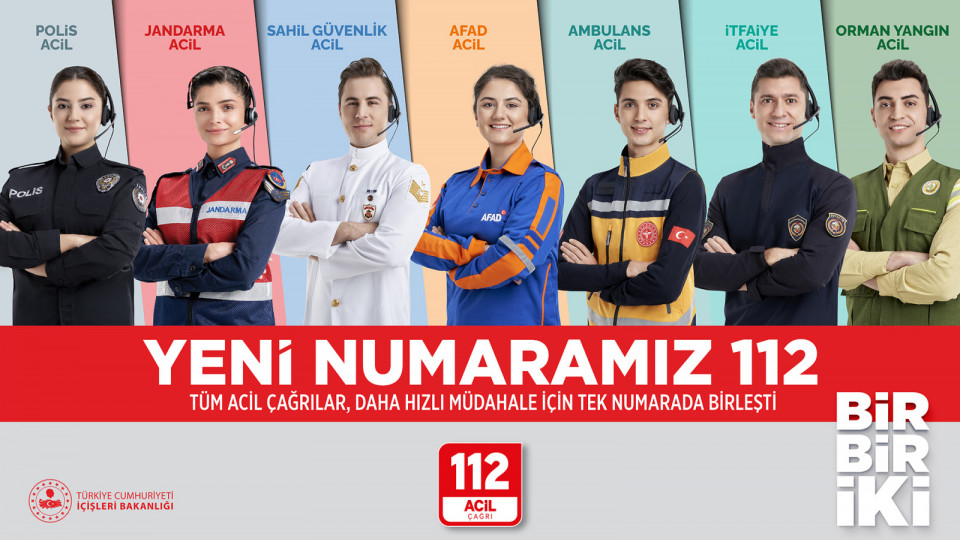
In an accident in Türkiye, safety of life always comes first. If anyone is injured or killed, call the 112 Emergency Call Centre and disturb the scene as little as possible.
Damage-only accident
If no one is hurt and both sides agree on how it happened, you can fill in an accident report form (kaza tespit tutanağı). Photograph the scene, making sure plates and points of damage are clearly visible.
Accident with injuries
Call 112 without disturbing the scene. Don’t attempt uninformed first aid on the injured — wait for the police/gendarmerie and medical teams.
When you need the police or gendarmerie
Where there’s suspected alcohol or drugs, driving without a valid licence, a public-service vehicle involved, damage to public property, or an uninsured vehicle, the report must be drawn up by the competent authorities, not agreed between the parties.
For foreign-plated vehicles
The validity dates of your traffic insurance or Green Card, your policy number, and your driver/vehicle documents may all be needed during the report and claims process.
Practical Checklist for Drivers of Foreign-Plated Vehicles
- Check how long your licence is valid for in Türkiye, and whether you need a translation.
- Keep your passport/entry-date details ready to show if asked.
- Check the validity dates of your traffic insurance or Green Card.
- Go by the signs on the road for speed limits.
- In an accident, put safety first, then follow the order: photos, report, insurance notification.
Official Sources and Downloadable Guide
For current practice, always rely on official announcements, traffic signage and instructions from the competent authorities. The links below can be used for further information and to double-check details.
Getting more out of this guide
This extra section is meant to connect the topic to practical decisions for your trip. In every case, the final scope of cover, duration, premium and acceptance conditions are set by the relevant insurer’s quote and policy terms.
Checklist: Turkish traffic rules
- Before you travel, check the rules on speed limits, seat belts, child seats and mobile phone use.
- Go by the signs and road conditions when driving in town, out of town and on motorways.
- In an accident, breakdown or emergency, call 112 and follow the official instructions.
Common mistakes
- Not checking document dates, entry-exit records and policy dates together.
- Treating insurance documents as enough without checking traffic rules, entry-exit records and vehicle-use restrictions together.
- Leaving entry, permitted usage period and authorised-driver details to the last minute.
Important notice: Gurbet Kasko is not an insurance company. Özhedef Sigorta Aracılık Hizmetleri Limited Şirketi, registered in the TOBB Register under number T0869-R991, acts as an insurance agent providing information, requests and quotes to owners of foreign-plated vehicles.
Have your documents ready before starting a request or quote; missing or conflicting information can delay the process.
2026 points to check
KGM speed-limit tables and EGM traffic safety guidance show that speed-limit compliance matters both for fines and for accident risk. Road signs, temporary speed limits and police or gendarmerie instructions take priority over general tables.
For foreign-plated vehicles, authorised use is a separate issue. The presence of the vehicle owner or permit holder in Türkiye, the driver’s residence-abroad status and the family relationship are assessed together. For people resident in Türkiye, the scope for driving such a vehicle is very limited; emergency-use exceptions and official records should be checked separately.
A traffic violation can affect fault and insurance assessment after an accident. Sending a request or information form does not issue a policy or start cover; the final assessment depends on official records and the policy issued by the relevant insurance company.
Frequently asked questions
Which speed limit applies in Turkiye?
General limits depend on vehicle type and are published by KGM, but road signs, temporary restrictions and official instructions always take priority.
Can family members drive a foreign-plated vehicle in Turkiye?
In some cases, yes. In general, the permit holder’s presence in Türkiye, the driver’s residence-abroad status and close family relationship such as spouse, ascendants or descendants matter. While the permit holder is in the vehicle, other people resident abroad may also be allowed to drive; for people resident in Türkiye, only narrow emergency-use exceptions may apply.
What should I do first after an accident?
Secure life safety first, call 112 if needed, make the scene safe and, if the situation is suitable, collect photos and details for a material-damage accident report.
Can a traffic violation affect insurance handling?
Yes. Violations and fault findings may affect claim, recourse or policy assessment. The final outcome depends on policy terms and official records.
Does Gurbet Kasko provide traffic insurance or cover?
Gurbet Kasko is a service brand used by Özhedef Sigorta Aracılık Hizmetleri. Özhedef Sigorta Aracılık Hizmetleri acts as a TOBB-registered insurance agency for information, application and quotation processes; insurance cover is subject to the policy and special terms issued by the relevant insurer.
Related guides: Turkiye travel guide · Before driving to Turkiye · Accident report · Compulsory traffic insurance · General guide
Gurbet Kasko is a service brand used by Özhedef Sigorta Aracılık Hizmetleri Limited Şirketi. Özhedef Sigorta Aracılık Hizmetleri acts as a TOBB-registered insurance agency for information, application and quotation processes. Gurbet Kasko and Özhedef Sigorta Aracılık Hizmetleri do not act as insurance companies or cover providers.
Gurbet Kasko
Follow Gurbet Kasko on social media
We share guides on foreign-plated cars, insurance steps and driving in Türkiye on our social channels too.